
THE MOUNTAIN FRAMEWORK
We often talk about change as though it should follow a predictable path: decide what you want, make a plan, stay consistent, reach the goal.
Real life is rarely that orderly.
There are times when we know something needs to be different but aren’t yet sure what. Times when we can see where we want to go but don’t know how to begin. Times when we’re making progress and times when the path becomes harder than expected. We may reach something we worked toward for months only to discover that the real challenge is learning how to carry that change into the rest of our lives.
And sometimes, after all that movement, we realize there is another mountain entirely.
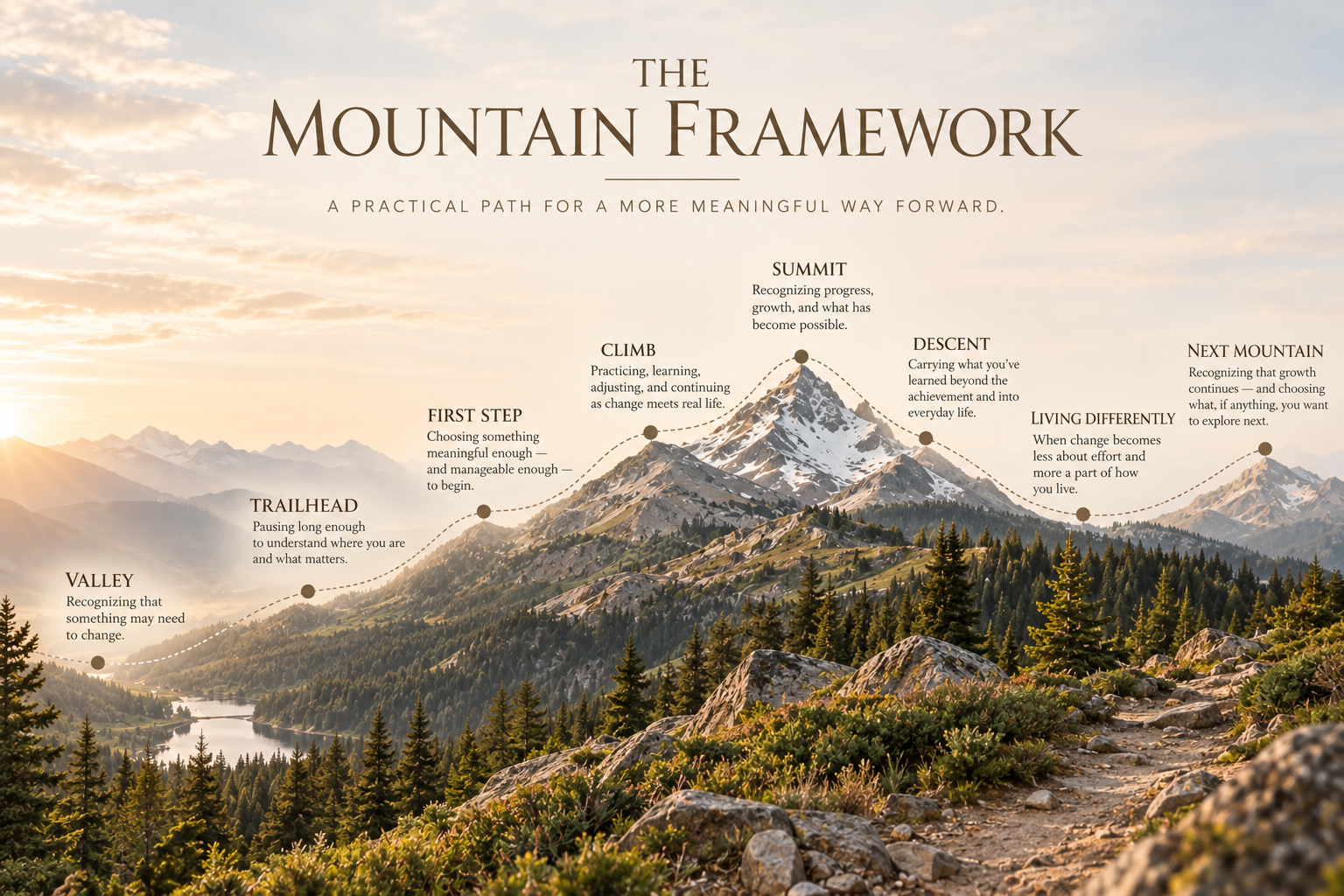
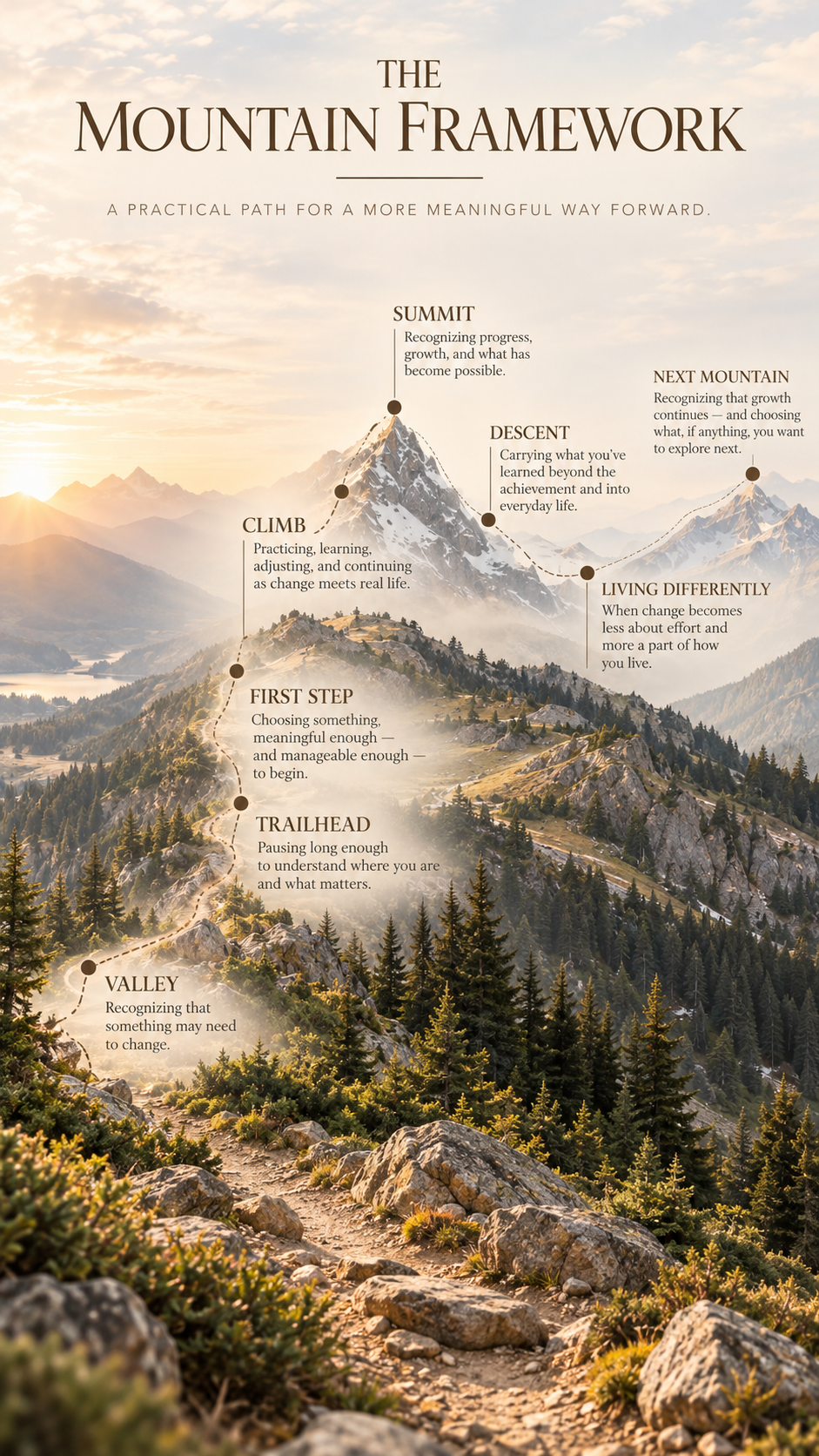
The Mountain Framework is Mountain Awakening’s way of making room for that complexity. It offers a landscape for understanding change—from the Valley through the Trailhead, First Step, Climb and Summit, and then through the equally important Descent, Living Differently, and whatever Next Mountain may—or may not—come into view.
It is a framework, not a formula.
You don’t have to move through it in order. There is no timetable for reaching the Summit. You can pause, circle back, recognize yourself in more than one place, or discover that the destination you once imagined is no longer the one that matters.
The purpose of The Mountain Framework isn’t to tell you where you should be.
It helps you understand where you are.
CHANGE HAS A LANDSCAPE
eight places on the mountain. no prescribed route
between them.
The Mountain Framework offers eight places that can help us recognize different experiences of change. They aren’t steps to complete or boxes to check. You may move among them in ways that are uniquely your own.
THE VALLEY
The Valley is where awareness begins.
You may know that something isn’t working the way you want it to, even if you can’t yet name exactly what needs to change. Perhaps an old routine no longer fits. Something you’ve been tolerating has become harder to ignore. Or you simply recognize a growing distance between how you’re living and how you want to live.
The Valley isn’t a place of failure. Nor does being there mean you need to start climbing immediately. Sometimes the most meaningful thing we can do is notice what is true before deciding what to do about it.
Awareness is movement, too.

THE TRAILHEAD
The Trailhead is a place to orient yourself.
Before choosing a direction, it helps you understand where you are, what matters to you, what you’re carrying, and what the terrain around you actually looks like. This is a place for curiosity, not urgency.
You may begin considering what you want to be different, what you’ve tried before, what has helped, what hasn’t, and what you’re genuinely ready for now. Sometimes the destination becomes clearer. Sometimes you discover that the mountain you thought you needed to climb isn’t actually the one asking for your attention.
The Trailhead doesn’t demand a commitment to climb.
It creates enough space to choose more intentionally.

THE FIRST STEP
The First Step is where possibility becomes action.
It doesn’t need to be dramatic. In fact, a meaningful first step may be much smaller than the kind of sweeping change we’re often encouraged to make. What matters is that the step belongs to you, connects to something you value, and is realistic enough to take within the life you’re actually living.
A first step doesn’t prove how committed you are.
It gives you something more useful: an opportunity to learn.

THE CLIMB
The Climb is where change meets real life.
This is the practice—not simply repeating something perfectly, but learning what helps, noticing what gets in the way, adjusting when circumstances change, and continuing to build evidence about what works for you.
Sometimes stretches may feel energizing. Others may be slow, frustrating, or surprisingly difficult. You may need to change pace, choose another route, rest, or revisit something you thought you had already figured out.
That isn’t necessarily moving backward.
It may simply be part of learning how to keep moving in a way you can sustain.

THE SUMMIT
The Summit is a place to recognize what has changed.
Sometimes there is a clear achievement to celebrate. Other times, the most meaningful progress is less visible: a behavior that becomes easier, a choice that now feels more natural, greater confidence in your own decisions, or the realization that you handled something differently than you once would have.
The Summit creates space to notice those things—to look back at the terrain you’ve traveled and recognize the evidence of your own growth.
Because progress deserves to be recognized by the person who made it.
And then comes something many approaches to change barely mention:
You still have to come down the mountain.
THE DESCENT
The Descent is where accomplishment meets everyday life.
Reaching something is different from learning how to live with what has changed. The structures, attention, or motivation that supported the Climb may not always be present. Life continues. Responsibilities shift. New challenges appear.
The Descent is an opportunity to integrate what you’ve learned—to understand what you want to carry forward, what no longer needs as much effort, what still needs attention, and how you will respond when life inevitably disrupts the plan.
The goal isn’t to preserve a perfect Summit experience.
It’s to bring something useful home with you.

LIVING DIFFERENTLY
Living Differently is less about maintaining a program and more about recognizing what has become part of your life.
Perhaps you respond to setbacks differently. You trust yourself more. You notice your needs earlier. A behavior that once required constant effort now fits more naturally into your day. Or you’ve learned how to adjust without interpreting every disruption as a reason to start over.
This doesn’t mean change is finished or life becomes effortless.
It means something has become different enough that you’re no longer relating to it in quite the same way.

THE NEXT MOUNTAIN
Eventually, another mountain may come into view.
It might be another area of wellness. It might have nothing to do with wellness at all. Growth in one part of life can change what we notice, what we believe is possible, or what we’re ready to explore.
But The Next Mountain isn’t an obligation.
You don't have to constantly improve, optimize, or find another thing to work on. Sometimes Living Differently is exactly where you want ot stay for a while.
And if another mountain does begin calling for your attention, you don’t arrive at it empty-handed.
You bring with you what you’ve learned about change—and about yourself.

A mountain can look wonderfully orderly when drawn on a page. Real change rarely feels that way while you’re living it.
You may take a First Step and discover that you need more time at The Trailhead. You may be well into a Climb when life changes and asks you to reconsider the route. You may reach a Summit in one area of your life while feeling firmly in the Valley somewhere else. And something you thought you had already worked through may deserve your attention again—not because you’ve failed, but because you’re meeting it from a different place.
Sometimes the most appropriate thing to do is pause. Rest can be part of the journey. So can reconsidering the destination. So can deciding that a mountain you once intended to climb no longer matters enough to keep climbing.
The Mountain Framework doesn’t measure progress by how quickly or neatly you move through it. It gives you language to notice what is happening, recognize what you may need, and make more intentional choices about what comes next.
Sometimes progress is movement.
Sometimes it’s adjustment.
Sometimes it’s recognizing that the path has changed.
And sometimes it’s choosing to stay exactly where you are for a while.
THE PATH ISN’T LINEAR
Your path doesn’t have to
look like anyone else’s.

BEYOND THE SUMMIT
The Summit matters.
What you carry home matters, too.
We naturally notice achievements. The goal reached. The milestone crossed. The moment when we can finally look back and say, I did that.
Those moments matter. They deserve recognition.
But sustainable change asks another question:
What happens when the moment is over?
A Summit can show you what you’ve accomplished, but The Descent begins to reveal what you’ve learned. It’s where the focus gradually shifts from reaching something to integrating something—from pursuing change to understanding how that change belongs in the rest of your life.
That may mean recognizing which behaviors you want to continue and which structures you no longer need. It may mean noticing how you respond when routines are disrupted. It may mean learning that flexibility can be a form of consistency, not evidence that you’ve fallen off track.
And it may mean recognizing something even more personal: you have evidence now.
Evidence that you can make a meaningful choice. That you can learn from something that didn’t work. That you can adjust. That you can begin without erasing what came before. That you can recognize your own progress without waiting for someone else to validate it.
This is why Mountain Awakening doesn’t treat the Summit as the end of the story.
The goal isn’t simply to reach something.
It’s to carry forward what reaching it taught you.

FRAMEWORK & COACHING
The Framework can help us understand the journey. You still choose the path.
The Mountain Framework informs how I think about change and the conversations we may have in coaching, but it is not an eight-stage program every client is expected to complete.
There is no Week One Valley, Week Three Trailhead, or Week Eight Summit.
Coaching begins with the person in front of me. We explore what matters to you, what is happening in your life, what you want to be different, and what you may be ready to work on. The Framework can give us language for understanding parts of that experience, but it doesn’t determine your goals, your pace, or the direction your coaching must take.
You may recognize that you’re standing at The Trailhead in one part of your wellness while already deep into a Climb somewhere else. You may discover that what you need most isn’t another First Step but permission to pause and reconsider the mountain. You may reach a Summit during our work together—or the most meaningful progress may be something quieter that doesn’t fit neatly into any single place.
That’s why Mountain Awakening Coaching is individualized.
The Framework provides orientation. Behavior-change principles give us useful tools. Coaching provides a relationship in which you can explore, learn, make decisions, practice, reflect, and adjust.
But the path remains yours.

WHERE ARE YOU NOW?
You don’t need a name for it.
Maybe something in The Valley felt familiar. Maybe you’re standing at a Trailhead, aware that you’d like something to be different but not yet certain what that means. Perhaps you’ve already taken a First Step, or you’re somewhere in the middle of a Climb, trying to understand why something that mattered to you has become difficult to sustain.
You might even be coming down from a Summit, wondering how to carry what you’ve accomplished into ordinary life.
Wherever you recognize yourself, there is nothing you are supposed to do simply because you’ve found your place on the Mountain.
You can notice.
You can stay curious.
You can decide whether anything needs to happen next.
And if you would like a conversation about where you are, what matters to you, and whether coaching might be useful, The Trailhead is a place to begin.
The Trailhead is a complimentary, approximately 30-minute conversation. There is no obligation to continue into coaching. It’s simply an opportunity for us to talk, explore what brings you here, and determine whether Mountain Awakening Coaching might be an appropriate next step.

You don’t need to arrive with a plan.
You can begin exactly where you are.